
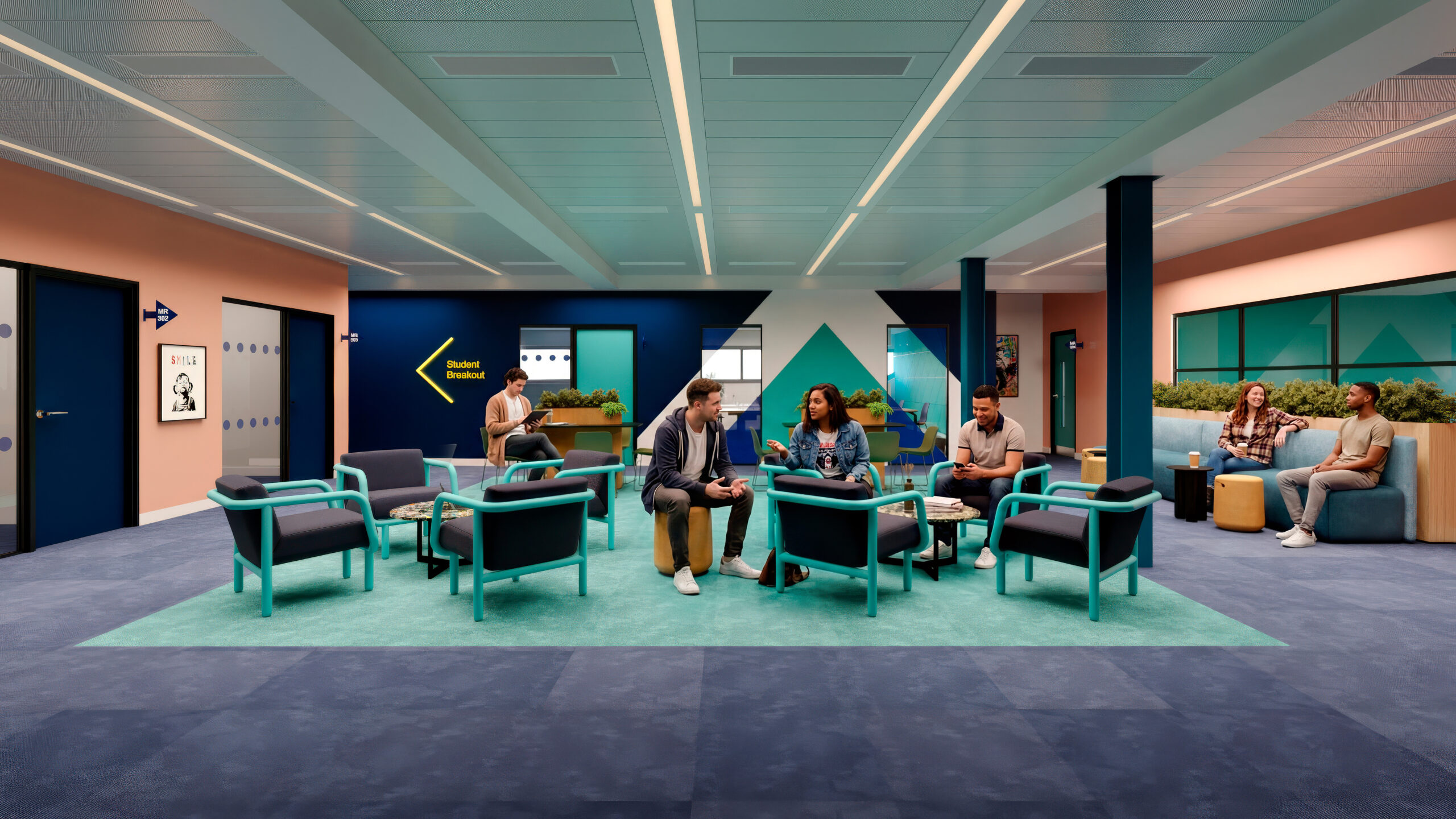
Future-Proofing Educational Spaces Using Technology

The role of educational space has changed significantly in recent years. Learning environments are no longer viewed simply as places to deliver teaching, but as active tools that support collaboration, wellbeing, flexibility, and digital engagement.
As teaching methods and technology continue to evolve, schools, colleges, and universities are increasingly looking at how their physical environments can adapt alongside them. The challenge is not just creating spaces that work well today, but designing environments capable of supporting the needs of future learners for years to come.
For education leaders and estates teams, future-proofing has become an important part of long-term investment strategy, balancing technology integration, spatial flexibility, and user experience to create environments that remain relevant, effective, and resilient over time.
Why Technology Integration Has Become Non-Negotiable
The pandemic accelerated a shift that was already well underway. Hybrid learning, virtual collaboration tools, and cloud-based platforms moved from “emerging” to standard almost overnight. Since then, institutions have been in a race to align their environments with digital infrastructure students and teachers can depend on.
Interactive displays, room-booking systems, occupancy sensors, high-speed wireless networks, and AV-enabled teaching walls are no longer just aspirational. They are often the foundations of many functional modern learning spaces. Many educational environments across the UK were originally designed for more traditional teaching methods, which can make integrating modern technology more complex today.
In many cases, technology has been introduced incrementally over time as needs have evolved. While this approach can solve immediate challenges, it can sometimes lead to issues around usability, cable management, acoustics, and long-term flexibility.
Getting this right requires more than just a technology brief. It demands a purposeful design-led approach that integrates infrastructure, acoustics and spatial planning from the very beginning.
Designing for the Infrastructure First
One of the very important lessons we take from educational projects is this: technology performs best when the environment is designed to support it. Before any tech is installed, the underlying physical space must be considered. Considerations include:
- Planning for power access at desk level across a variety of configurations
- High capacity wireless networking that doesn’t degrade in heavy usage
- Thinking carefully about cable management
- Future technology evolution
At Cobus Spaces, our work at Wellington College is a strong example of what this looks like in practice. The college wanted to transform its learning environments into spaces that would genuinely support the evolving needs of both students and educators. We began with function over aesthetics. We designed a versatile layout with high-quality modular furniture that could be reconfigured for different lesson formats. Alongside this, spatial planning ensured collaborative and individual learning could co-exist.
Getting the infrastructure right from the outset is what allows institutions to invest with confidence. Knowing the spaces they create today won’t become obstacles tomorrow.
What does Smart Technology look like in Educational Spaces?
Technology in education works best when it’s invisible. When it improves what’s happening in the room without causing unnecessary attention to itself.
Several areas of smart technology are now becoming standard in well-designed UK educational spaces:
Interactive Displays and Teaching Walls Many institutions are now complementing traditional teaching tools with interactive displays that support more collaborative and dynamic learning experiences. When positioned correctly within a thoughtfully designed space, with appropriate sightlines, lighting levels managed to reduce glare, and acoustic panels to improve clarity, these systems transform how content is delivered and discussed.
Room Booking and Occupancy Management. For institutions managing multiple buildings, departments, and shared spaces, room booking systems and occupancy sensors provide valuable insight into how spaces are actually being used. This data informs future investment decisions, reduces wasted space, and helps facilities teams optimise the estate.
Acoustic Intelligence. Sound management is one of the most underestimated challenges in educational design, and one of the most critical. Background noise in open learning areas, breakout pods, and shared study zones can significantly undermine the effectiveness of both technology and teaching. Acoustic panels, specialist ceiling systems, and sound-insulated collaboration spaces create the conditions in which technology can perform at its best and learners can concentrate fully.
Flexible AV for Hybrid Teaching. With hybrid learning models now embedded in many higher education settings, the ability to seamlessly connect in-person and remote participants has become a standard expectation. This requires camera positioning, microphone integration, and display systems to be considered as part of the room design, not installed as a standalone afterthought following the build.
Flexibility & Future-Proofing
The most effective way to future-proof an educational space is to design it to be adaptive. This ensures the space can evolve with new technology in the future.
Modular furniture has become central to educational design. Mobile desks, reconfigurable seating, and foldable partitions allow a single room to transition seamlessly. Educational layouts are required to switch between lecture formats, group workshops and allow for breakout collaborations. The physical environment stops being fixed and starts being responsive.
Institutions that invest in adaptability at the design stage spend less on reconfiguration in the years that follow. This is particularly important for schools and colleges navigating tighter budgets. A responsive space with scalable technology is a considerably more reliable investment than a series of reactive upgrades to a space never designed for tech in the first place.
Wellbeing and Technology in Sync
It’s tempting to think of technology integration and wellbeing design as separate. In reality, they are deeply connected. Research continues to demonstrate that educational environments have an important influence on focus, stress levels, and cognitive performance.
A 2025 research review from the University of Portsmouth found that the physical conditions of a learning space have a measurable impact on student mental health and academic performance. Considerations such as:
– quality of lighting
– management of sound
– availability of natural elements
– ergonomics of furniture
These all affect how students can learn, regardless of how sophisticated the technology around them is.
A classroom with cutting-edge interactive displays but poor acoustics, glaring overhead lighting, and rigid seating is not a high-performing learning environment. Equally, a beautifully designed biophilic space without the infrastructure to support modern teaching tools will frustrate both educators and students.
The most impressive educational spaces bring these elements together, designing for wellbeing and technology at the same time. Natural materials and thoughtful colour palettes reduce stress. Strong acoustic design improves concentration and allows AV technology to perform as it should. Flexible layouts give students agency over how they engage with their environment. Ergonomic workstations support sustained focus for individual study.
The Cobus Spaces Approach to Educational Design
For more than four decades, Cobus Spaces has been delivering educational environments across the UK. We’ve worked with prestigious independent schools like Wellington College and many other education institutions seeking to transform their campuses.
Our end-to-end approach means we take responsibility for every stage of the process. We remove design uncertainty early, manage risk transparently, and ensure that institutions perform to their full potential from day one and evolve with the times.
Technology integration is not a bolt-on consideration in our process. It is woven into the design strategy from the very beginning. The result is spaces where students and educators can thrive, and where institutions can invest with confidence